
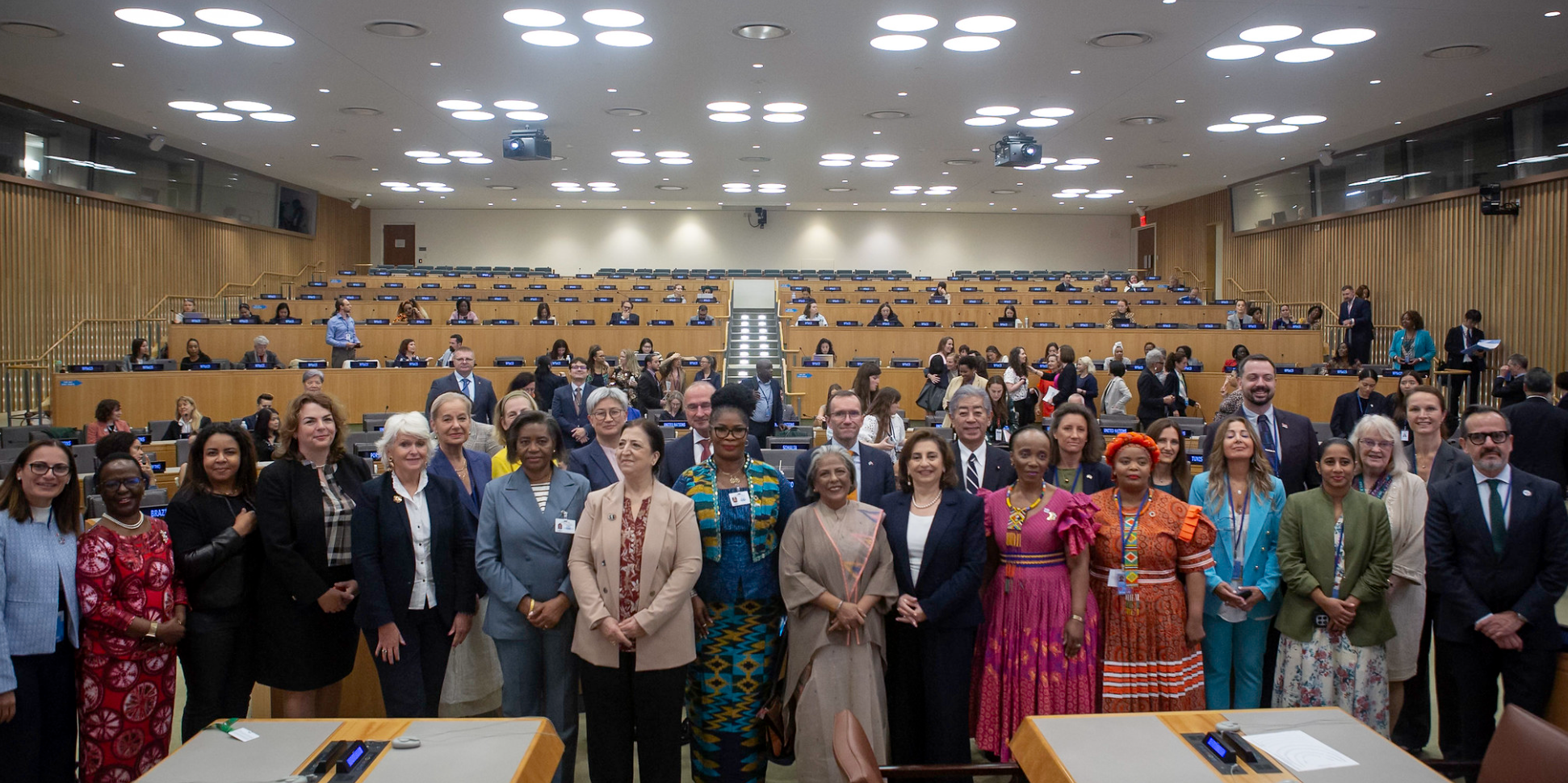
On 24 September 2025, the WPS Focal Points Network held its annual ministerial event in New York, during the 80th session of the United Nations General Assembly. The event marked the 25th anniversary of UN Security Council Resolution 1325 on Women, Peace and Security (WPS), and was held under the theme: Deepening WPS Commitments for Action: innovating and adapting to deliver on peace and security.
The event was co-hosted by Japan and Norway, the 2025 Co-Chairs of the Network, in collaboration with UN Women, which serves as the Network Secretariat. It brought together over 500 participants, including Namibia’s first female president, 30 ministerial speakers, and senior officials from more than 35 Member States and regional organizations, including the African Union (AU), the Organization for Security and Co-operation in Europe (OSCE), and the European Union (EU). Amid global pushback on women’s rights, the event demonstrated strong political commitment to the WPS agenda and to multilateralism across all regions.

Photo: UN Women/Ryan Brown
Building on outcomes from earlier meetings in Tokyo and Oslo, speakers emphasized the importance of embedding WPS across peacebuilding, diplomacy, and national security strategies. Japan’s Foreign Minister Takeshi Iwaya, reaffirmed Japan’s commitment to leverage its experience as Co-Chair and to “continue to vigorously promote WPS as one of the main pillars of [Japan’s] foreign policy, further contributing to the international promotion of WPS.” Norway’s Foreign Minister Espen Barth Eide, recalled that “it is the Security Council that passed this resolution, so it’s part of our peace and security agenda here in our United Nations,” while Namibia’s President Netumbo Nandi-Ndaitwah, observed that “the magnitude at which this resolution has grown is testimony to its relevancy and our collective commitments to ensuring international peace and security.” She urged participants to “continue keeping the spirit of Resolution 1325.”
Noting the grim reality of more than 600 million women and girls living within 50 km of armed conflict, UN Women Executive Director Sima Bahous highlighted the troubling trend of “turning ever more frequently to war and investing precious resources in the weapons of war instead of its prevention and resolution.” She emphasized the often-overlooked reality behind the headlines: that every day, women are preventing conflicts and fostering peace in their communities. This point was reinforced by civil society speaker Shaza Elmahdi of Centerlink Sudan, who called for urgent investment in women’s peace efforts, warning of the consequences when funding is withdrawn due to budget constraints. “If funding for women is always first to be cut, then women’s safety and security are never truly seen as essential,” she stated.
Network members shared national and regional actions to advance WPS – particularly through the development, adoption, and implementation of national action plans (NAPs). To date, 115 governments have adopted at least one NAP. Chile, Denmark, and Serbia adopted new NAPs this year, while new plans are in the pipeline in Armenia, Portugal, Slovenia, and Tunisia. Bolivia, France, Germany, Lebanon, Liberia, Namibia, and South Africa also noted ongoing processes to develop new plans.

Photo: WPSFocalPointsNetwork/Babita Patel
Speakers highlighted a range of specific efforts, including institutionalizing gender-responsive budgeting (Bangladesh, Senegal), collecting gender-disaggregated statistics (Sweden) and establishing monitoring databases (Portugal). They also reported on promoting intergenerational leadership (Brazil, Croatia, Japan, Namibia, OSCE, Zimbabwe), including women in peacekeeping (Angola, Bangladesh, Namibia, Peru, Portugal, Senegal, South Africa), and engaging civil society (Chile, Namibia, Norway, Romania, Sierra Leone, Slovenia, Sweden). Colombia noted initiatives focused on Indigenous, Afro-descendant, and rural women.
In addition, Bangladesh, EU, Hungary, Liberia, Romania, and Sierra Leone shared progress in advancing women’s leadership in national defense and security.
On emerging issues, Canada, Chile, the Democratic Republic of the Congo (DRC), Germany, Japan, Lao PDR, Lebanon, Slovenia, and the Philippines shared their work on climate security and disaster prevention and response. Armenia, DRC, Canada, and Lebanon also highlighted efforts on artificial intelligence and cybersecurity.

Photo: WPSFocalPointsNetwork/Babita Patel
Speakers throughout the event strongly supported women’s full, equal, meaningful, and safe participation in peace processes. Norway’s Eide emphasized that “it’s not principally a question of counting women, it’s about making women count,” while Austria called for making gender equality a reality in every peace process. The AU and the EU reaffirmed their commitment to promoting women’s participation in peace and political processes led or supported by their organizations. Switzerland highlighted its efforts in the Syrian transition process, as well as its commitment to the UN Secretary-General’s Common Pledge for Women’s Participation, with Brazil and Portugal also referencing the pledge. The Netherlands announced the development of a new mediation support fund.
On conflict-related sexual violence, Australia announced its $1.5 million commitment to the Global Survivors Fund, while the United Kingdom reported support for 55,000 survivors this year. The DRC highlighted its National Fund for Reparations.
Against the backdrop of funding cuts for women’s rights and gender equality, Germany noted its role as the largest donor to the Women’s Peace and Humanitarian Fund (WPHF), with Spain, Norway, and the United Kingdom also reaffirming their support for the Fund. The Netherlands announced plans to launch a new WPS-focused grant instrument, and Sweden underscored the need to safeguard existing funding targets.
The WPS Focal Points Network, now comprising 96 Member States and 10 regional organizations, will mark its 10th anniversary in 2026. Speakers recognized the Network as a vital platform for coordinating action, sharing best practices, and driving accountability on women, peace and security. Reflecting on the high level of participation, Spain described the Network as both a necessity and a diplomatic success, especially in the face of ongoing backsliding on gender equality.
In the words of Shaza Elmahdi, “if we want to honor the promise of Resolution 1325, we must finally make it real and stand for all women, listen to them, and invest in their capacities.”
——–
To access the speaker list and view a recording of the event, visit: https://wpsfocalpointsnetwork.org/80th-unga-ministerial-level-side-event/




Published by